
June 4, 2026
Wondering if you can really live in downtown Chicago without relying on a car every day? In Lakeshore East, the answer is often yes. If you want a neighborhood where groceries, green space, transit, and waterfront paths fit into a compact daily routine, this part of the New Eastside stands out. Let’s dive in.
Lakeshore East was planned as a mixed-use district with walkable blocks, a central park, and direct links to the Chicago Riverwalk and lakefront parks. The broader master plan covers 28 acres and includes about 4,950 residences, roughly 2.2 million gross square feet of commercial space, and up to 770,000 square feet of retail.
That mix matters if you want to reduce car use. Instead of treating errands, outdoor time, and commuting as separate trips, you can often fold them into one walkable route through the neighborhood and nearby downtown.
Another reason car-free living feels realistic here is the amount of open space. The master plan describes 40% open space, which helps the neighborhood feel less like a dense cluster of towers and more like a residential district with room to move.
At the center of the neighborhood is Lake Shore East Park, a 5.09-acre public park operated by the Chicago Park District. It includes a playground, interactive water feature, dog-friendly area, gardens, paths, and open space, and it is open daily from 6:00 a.m. to 11:00 p.m.
For everyday life, that gives you a real outdoor hub close to home. You can walk the dog, meet friends, take kids to the playground, or simply get outside without planning a longer trip.
This is also an important part of what makes Lakeshore East feel livable without a car. A neighborhood works better on foot when useful public space is built into the routine, not tucked away as an occasional destination.
One of the biggest practical advantages in Lakeshore East is Mariano’s at 333 E Benton Pl. The store lists grocery, drug and general merchandise, plus pickup, a coffee bar, deli, sushi, wine tasting bar, and other prepared-food or convenience-focused departments.
In simple terms, that means you can handle a large share of your weekly errands in one place. For many residents, that cuts down on the kind of car trips that often feel unavoidable in other neighborhoods.
The store currently lists daily hours of 6 a.m. to 10 p.m. That kind of schedule gives you more flexibility if you are fitting shopping into a workday, an evening walk, or a weekend routine.
Car-free living is not just about errands. It also depends on whether the neighborhood makes it easy to get outside, stay active, and enjoy the city without extra planning.
In Lakeshore East, the Chicago Riverwalk is part of that equation. The Chicago Architecture Center describes it as a contemporary downtown park, and notes that the segment east of Michigan Avenue was built to resemble the Lakefront Trail. It also highlights activities such as dining, performances, kayaking, and fishing.
That gives you another way to move through downtown on foot. Instead of being a once-in-a-while attraction, the Riverwalk can feel like an extension of your regular walking loop.
The neighborhood also has stronger lakefront continuity than many buyers realize. Magellan states that the Cirrus and Cascade development area added a new bike and walking path connecting Lakeshore East Park to the Lakefront Trail, making it easier to move from the heart of the neighborhood toward the water without needing a car.
Strong walkability matters, but a truly car-free routine also depends on transit. Lakeshore East benefits from a dense network of nearby CTA and Metra access points rather than relying on just one station.
The CTA Lake Red Line station is accessible, includes indoor bike parking, and connects to bus routes 29, 36, 146, and 148. CTA also notes Pedway-based transfer options to the Blue Line and to elevated lines, which can be especially useful in winter or when you are heading into different parts of the Loop.
Washington/Wabash is another major option nearby. CTA lists it as accessible and served by the Brown, Green, Orange, Pink, and Purple lines, with bus connections including J14, 20, 56, 60, 124, and 157.
That range gives you flexibility. If one route is less convenient for your destination, you usually have another nearby option.
There is one important current caveat. As of June 1, 2026, CTA says the State/Lake station is closed for reconstruction into 2029, and riders are directed to use adjacent stations such as Clark/Lake or Washington/Wabash.
Millennium Station adds another layer of access. Metra lists numerous CTA bus connections there, including routes 3, 4, 6, J14, 19, 20, 26, 56, 60, 124, 143, 146, 147, 148, 151, and 157, along with connections to the Green, Pink, Orange, Brown, and Purple lines.
For many residents, that transit web is what makes car-free downtown living practical instead of aspirational. You are not limited to one train line or one corner of the neighborhood.
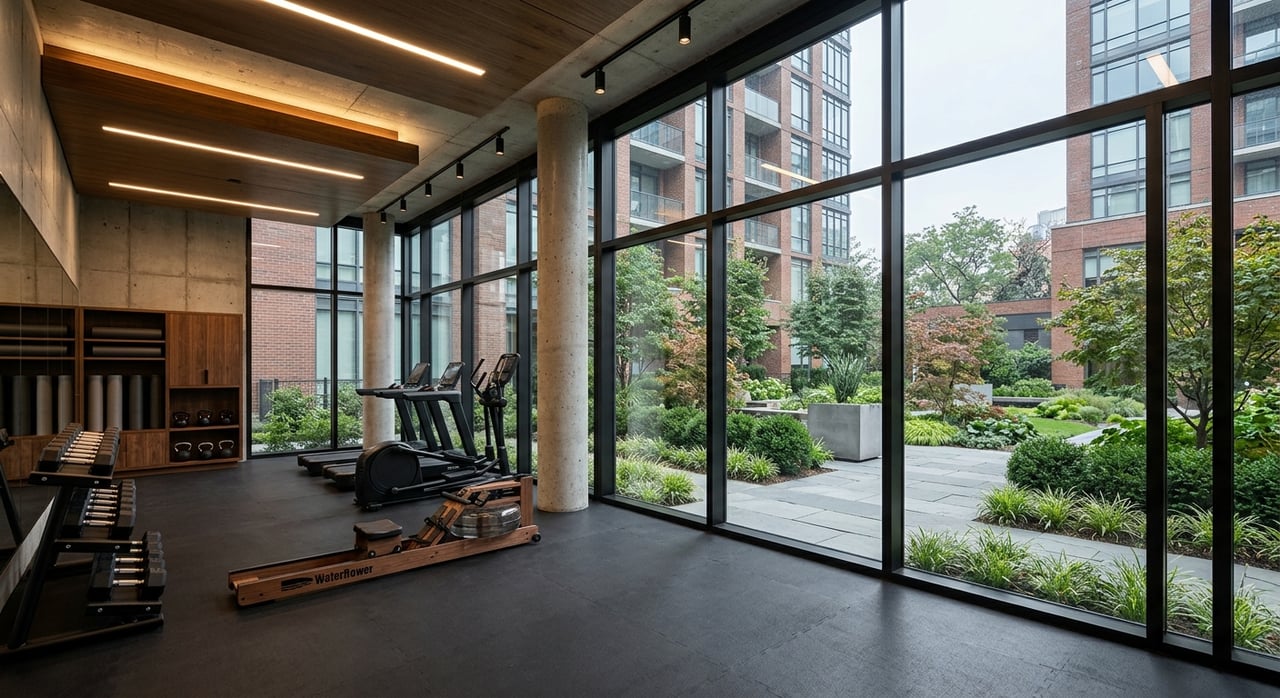
Another reason Lakeshore East can work well without a car is that many residential towers offer extensive on-site amenities. These vary by building, but in some cases they cover needs that might otherwise send you across town.
For example, Cirrus advertises about 30,000 square feet of amenity space, including indoor and outdoor pools, spa and massage rooms, a fitness center, a wine cellar and tasting room, a screening room, a kids club, coworking lounge, conference rooms, a dog-washing station, indoor and outdoor dog runs, and outdoor gathering areas.
340 on the Park lists a sky garden atrium, club room, fitness center with lap pool, and spa facilities. Cascade lists an outdoor deck with grills, a show kitchen, an indoor media room, and study rooms.
The St. Regis Chicago Residences highlight a 47th-floor amenity level with a pool and spa, a sky lounge, direct access to hotel amenities, a 5,600-square-foot fitness center with yoga and training studios, an indoor pool, a golf simulator, a cinema, private dining, a demonstration kitchen, a wine vault, a children’s club, and a dog lounge with an indoor dog run.
The takeaway is not that every building offers the same features. It is that many Lakeshore East properties are designed to support daily life at home, whether that means working remotely, exercising, hosting friends, or caring for a pet.
The strongest case for car-free living in Lakeshore East is not that you will never leave the neighborhood. It is that many of your regular needs can stay within a short walk or quick transit ride.
A typical day might include grabbing groceries at Mariano’s, walking through Lake Shore East Park, heading to the Riverwalk, and using nearby CTA or Metra connections for work or plans elsewhere downtown. That kind of compact routine is what sets this neighborhood apart.
It also helps to go in with realistic expectations. Transit patterns can shift, station access can change, and amenity packages vary from tower to tower. If you are comparing buildings, the details matter.
If you are serious about living with little or no car use, focus on more than the unit itself. The right building for you will depend on how you actually move through your week.
As you compare options in Lakeshore East, pay close attention to:
This is where local guidance matters. Two buildings may look similar on paper, but feel very different once you map out your daily routine.
If you are weighing condos in Lakeshore East or anywhere in downtown Chicago, the right fit comes from matching the building to the way you live, not just the finishes or the view. The team at HL2R Group can help you compare buildings, narrow the options, and find a home that supports the lifestyle you want.
Stay up to date on the latest real estate trends.
August 20, 2026
August 13, 2026
August 6, 2026
August 6, 2026
July 23, 2026

July 16, 2026
July 9, 2026
July 2, 2026
June 25, 2026
With combined experience in the industry spanning over two decades, these agents have joined forces to handle all of your real estate needs, specializing in neighborhoods from Chicago’s South Loop all the way into the North Shore suburbs.