November 19, 2026
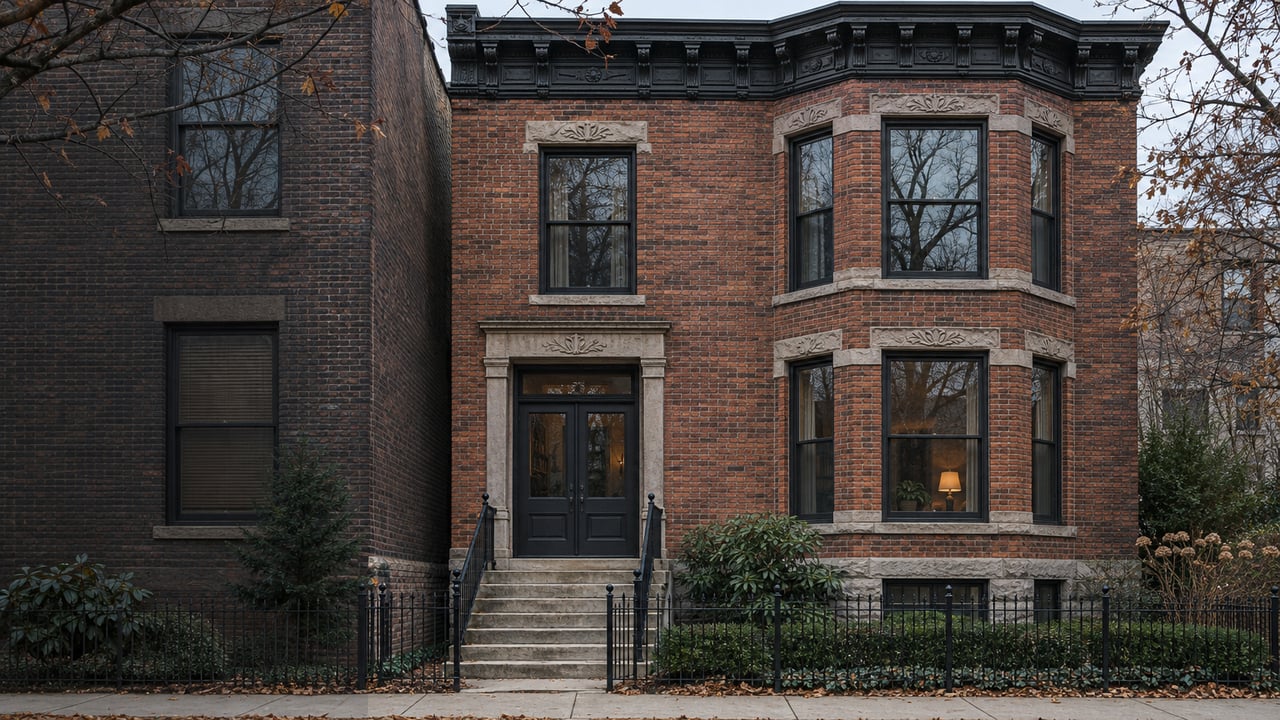
In 2025, business entities bought 6.5% of the condos sold in Lincoln Park. They bought 45.1% of the two-flats and other 2–4 unit buildings. Both kinds of property stand side by side in the neighborhood, and both were measured over the same calendar year by DePaul University's Institute for Housing Studies. For a buyer, though, the two are separate markets with separate competition.
When you shop for a condo here, business entities are a small slice of the competition. When you shop for a two-flat, close to half the other bidders are LLCs and companies, and Lincoln Park's recent history points to one likely reason a building like that interests them.
The IHS figures for Lincoln Park in 2025 line up like this:
| Property type, Lincoln Park | Share of housing units, 2025 | Sales, 2025 | Share bought by business entities, 2025 |
|---|---|---|---|
| Condominium | 44.3% | 963 | 6.5% |
| Single-family home | 11.7% | 252 | 18.3% |
| 2–4 unit building | 11.9% | 113 | 45.1% |
IHS uses "business buyer" broadly. The category covers everyone from a small local investor who holds a single building in an LLC to a large fund. The table doesn't say what those buyers did with the buildings. It does show that two-flats draw a different pool of bidders. In 2024 the business share of Lincoln Park's 2–4 unit sales was even higher, at 56.5%.
Two-flats and single-family homes make up nearly equal shares of the neighborhood's housing units. Two-flats are the only one of the two where close to half the buyers are companies.
For more than a decade, many of the neighborhood's small multi-unit buildings have been leaving the multi-unit category.
The Institute for Housing Studies tracked 2–4 unit buildings that disappeared from Chicago's housing stock between 2013 and 2019. In that period Lincoln Park lost 349 of them, totaling 968 units. About 51.6% of the lost parcels came back as single-family homes, and the neighborhood's stock of 2–4 unit parcels shrank 16.0%. Of all the city's 2–4 unit buildings that became single-family homes, Lincoln Park accounted for 7.9%. That put it fifth among Chicago community areas, behind North Center, Lakeview, West Town and Logan Square. When the study came out in May 2021, Block Club Chicago reported that the losses were concentrated on the North Side and described Lincoln Park as a neighborhood where many flats had already become single-family residences.
The IHS counts end in 2019. A more recent case came in January 2026, when Crain's Chicago Business reported on a 19th-century Lincoln Park greystone apartment building that was being redone as a single-family home.
The IHS data don't record what any business buyer planned for a building. A buyer who does intend to convert, though, would reasonably price a two-flat by what the finished single-family house could sell for, and in Lake View/Lincoln Park that number has been climbing.
DePaul's Cook County House Price Index for the second quarter of 2026, released October 15, puts the combined Lake View/Lincoln Park submarket at $1,538,000 for single-family homes. Single-family prices in that submarket rose 10.6% between the second quarters of 2025 and 2026. Among Chicago submarkets, only Bridgeport/Lower West Side rose faster, and the citywide gain was 5.7%.
The longer view is different. Since the start of the pandemic, Lake View/Lincoln Park single-family prices are up 33.4%, one of the smallest gains in Chicago. Over the same stretch, city prices rose 60.0%. IHS groups the submarket with other higher-cost markets where growth was slower. For most of the past five years, Lincoln Park single-family prices climbed gradually. Over the last year they climbed sharply.
These are single-family figures for a submarket that also includes Lakeview, so they aren't Lincoln Park two-flat prices. They do measure the market a converter sells into. As finished single-family homes gain value, a building that can become one is worth more to the buyers set up to do the work. The same building is worth no more to a household that wants to live in one unit and rent out the other.
The 2025 sales count includes one trend that favors buyers who aren't business entities. Lincoln Park recorded 113 sales of 2–4 unit buildings in 2025, up from 85 in 2024 and 84 in 2023. The total is still well below the 171 sales of 2021.
Combine those counts with the business-buyer shares and the numbers get more specific. In 2024, business entities bought 56.5% of 85 two-flat sales, about 48 buildings, so roughly 37 went to other buyers. In 2025 they bought 45.1% of 113 sales, about 51 buildings, which leaves roughly 62 for other buyers. By these estimates, business purchases held about steady from one year to the next. Nearly all of the 2025 increase came from buyers who weren't business entities.
That doesn't guarantee a two-flat will be easy to win this winter. It does show that in 2025 more two-flats sold to buyers outside the business category than in either of the two years before.
A buyer in Lincoln Park is really choosing among three markets.
The condo market is the biggest, with 963 sales in 2025, and business entities made up 6.5% of its buyers that year. With so few entity bidders, competition there turns on timing, the building and how strong your offer is.
The single-family market had 252 sales in 2025, and business buyers took 18.3% of them. As the IHS conversion counts show, some of the neighborhood's single-family homes started out as two-flats.
The two-flat market is the smallest of the three. Close to half its buyers are entities, and any of them planning a conversion would weigh each building against the price of a finished single-family home. A household buying a two-flat to live in one unit and rent the other, or to keep both units for family, may be bidding against that math while working from a different budget. That suggests a household buyer competes best on two-flats with less potential as a single-family home, such as a building with sound rental units.
Is there a price index for Lincoln Park two-flats? No public index tracks current Lincoln Park two-flat prices. DePaul's quarterly index covers only single-family homes, and its latest reading for Lake View/Lincoln Park is $1,538,000 for the second quarter of 2026. Building-by-building sales comparisons are the most reliable guide.
How many two-flats come up for sale in Lincoln Park in a year? In 2025 there were 113 sales of 2–4 unit buildings, compared with 963 condo sales and 252 single-family sales over the same year.
Is Lincoln Park the only neighborhood where two-flats have become houses? No. From 2013 through 2019, North Center, Lakeview, West Town and Logan Square each accounted for a larger share of Chicago's two-flat-to-single-family conversions than Lincoln Park did. Lakeview alone lost 459 buildings in 2–4 unit use over the same period.
When close to half the other bidders are entities, a two-flat offer has to be ready to go: financing approved and the numbers for both units worked out before the showing. At HL2R Group, we represent buyers and investors on multi-unit purchases in Lincoln Park and Old Town, and our in-house loan originator can get you pre-approved before the right building comes up. If you already own a Lincoln Park two-flat and wonder what an entity buyer would pay for it, start with Get Your Home Valuation.
Stay up to date on the latest real estate trends.
November 26, 2026
November 19, 2026

November 12, 2026
November 5, 2026
October 29, 2026
October 22, 2026
October 15, 2026
October 8, 2026
October 1, 2026
With combined experience in the industry spanning over two decades, these agents have joined forces to handle all of your real estate needs, specializing in neighborhoods from Chicago’s South Loop all the way into the North Shore suburbs.